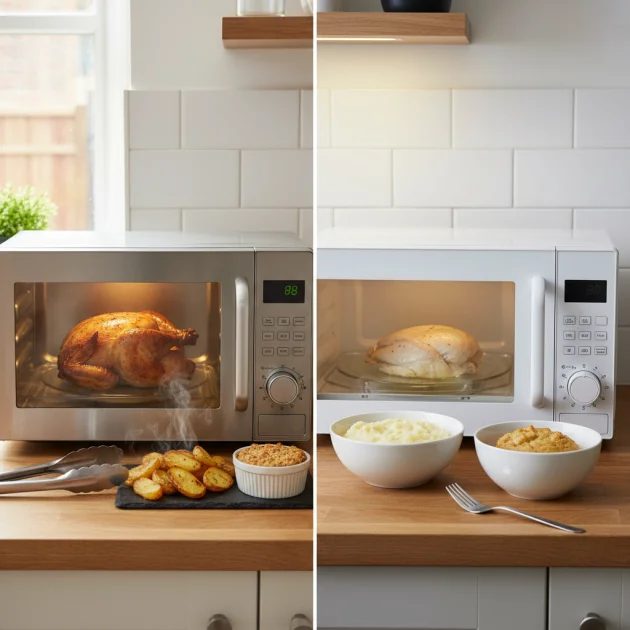
A conventional microwave heats food by exciting water molecules with microwaves, making it fast for reheating and defrosting, but it cannot brown or crisp food. In contrast, a convection microwave combines microwave technology with a heating element and a fan to circulate hot air, allowing it to bake, roast, brown, and crisp food in addition to standard microwave functions. This makes convection models more versatile, essentially acting as a 2-in-1 appliance for kitchens with limited space.
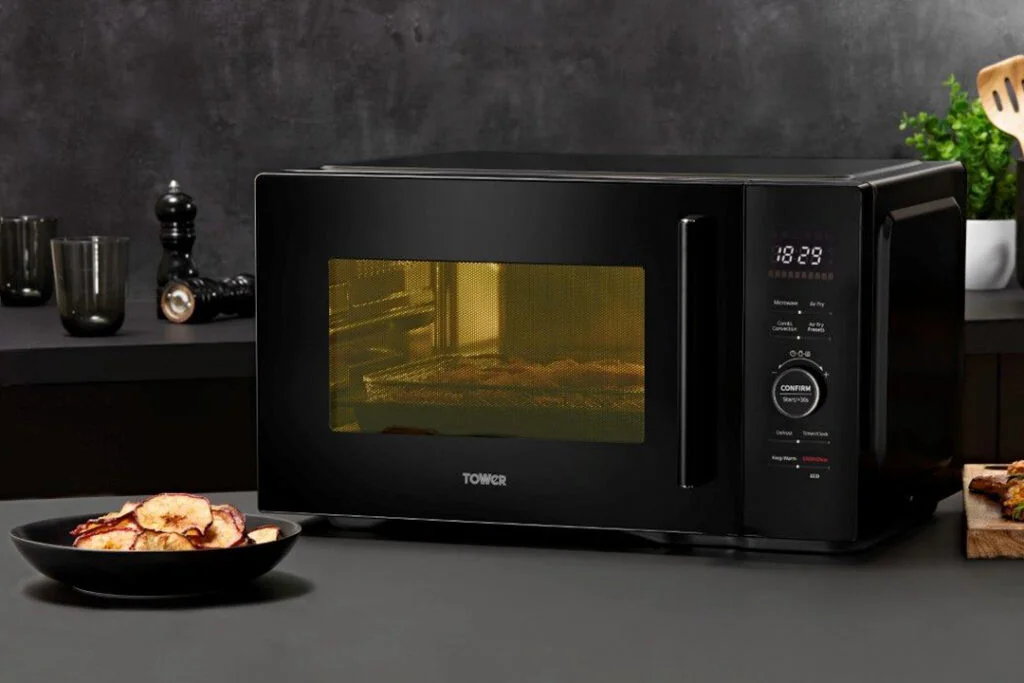 For shop curated microwave ovens on this site.
First Off, What Is a Conventional Microwave?
Let’s start with the classic we all know and love. A conventional microwave oven, or a standard microwave, is the original appliance for quick cooking. Its magic is all about, well, microwaves.
How Does a Standard Microwave Work?
Inside every standard microwave is a device called a magnetron. This little powerhouse generates invisible radio waves—microwaves. When you hit “start,” these waves bounce around the inside of the oven and, most importantly, cause the water molecules in your food to vibrate like crazy. This rapid vibration creates friction, which in turn generates heat, cooking your food from the inside out.
It’s incredibly efficient for certain tasks:
- Reheating leftovers: It’s the undisputed champion of turning last night’s dinner into today’s hot lunch in minutes.
- Defrosting: Forgot to take the chicken out of the freezer? The microwave has your back.
- Melting butter or chocolate: A baker’s best friend for quick prep.
- Steaming vegetables: A fast and healthy way to get your greens.
The key takeaway is speed. A conventional microwave uses microwave energy to heat the water content in food directly, which is why it’s so fast. However, it has its limits. It doesn’t brown or crisp food. That’s why microwaved pizza can end up with a soggy crust, and you’d never try to “roast” a chicken in one.
Enter the Convection Microwave: A Kitchen Game-Changer
Now, let’s talk about the more sophisticated sibling: the convection microwave. This isn’t just a microwave; it’s a hybrid kitchen appliance that combines two distinct cooking technologies into one compact box.
What Makes a Convection Microwave Different?
A convection microwave does everything a standard microwave can do. It still has a magnetron for zapping your food with microwave energy. But it has a secret weapon: a heating element and a fan.
This is the exact same technology found in a full-sized convection oven. The fan circulates hot air throughout the oven cavity. This circulating hot air cooks the food from the outside in, creating a dry, even heat that’s perfect for:
- Roasting: You can actually roast a whole chicken until it’s juicy on the inside with perfectly crispy, golden-brown skin.
- Baking: Cookies, small cakes, and brownies are all on the menu.
- Browning and Crisping: This is where it truly shines. It can reheat that pizza slice and make the crust crispy again, or give your baked potatoes a delicious, crunchy skin.
Essentially, a convection microwave gives you the speed of a microwave and the browning, baking, and roasting capabilities of a traditional oven. It’s like having a 2-in-1 appliance.
The Big Showdown: Convection vs Conventional Microwave
To really understand the difference, let’s put them head-to-head in a direct comparison. This is the core of the convection vs conventional microwave debate.
| Feature | Conventional (Standard) Microwave | Convection Microwave |
|---|---|---|
| Cooking Method | Uses microwaves to excite water molecules. | Uses microwaves, a heating element, and a fan to circulate hot air. |
| Cooking Results | Heats, steams, defrosts. Food can be soggy; does not brown or crisp. | Can do everything a standard microwave can, plus bake, roast, brown, and crisp. |
| Speed | Extremely fast for reheating and defrosting. | Slower for baking/roasting than microwave functions, but faster than a conventional oven. |
| Versatility | Limited to basic heating tasks. | Highly versatile. Can replace a small oven for many tasks. |
| Price | Generally more affordable. | More expensive due to the additional technology. |
| Size & Space | Comes in a wide range of sizes, including very compact models. | Often slightly larger and requires more clearance for heat ventilation. |
So, Who Should Buy Which?
The right choice really boils down to your cooking habits, kitchen space, and budget. There’s no single “best” option—only the best option for you.
You’re a Perfect Match for a Conventional Microwave If…
|
Our Picks for the Best Microwave Oven in 2026
As an Amazon Associate, we earn from qualifying purchases.
|
||
| Num | Product | Action |
|---|---|---|
| 1 | BLACK+DECKER EM720CB7 Digital Microwave Oven with Turntable Push-Button Door, Child Safety Lock, 700W, Stainless Steel, 0.7 Cu.ft |

|
| 2 | BLACK+DECKER Digital Microwave Oven with Turntable Push-Button Door, Child Safety Lock, Stainless Steel, 0.9 Cu Ft |
|
| 3 | Cooks Innovations Non-Stick Oven Protector Mat - Heavy Duty Nonstick Oven Rack Liners to Protect Convection, Electric, Gas, & Microwave Ovens - BPA & PFOA Free Heat Resistant Baking Mat |
|
| 4 | Breville BOV450XL Mini Smart Countertop Oven and Toaster Oven, Small, Brushed Stainless Steel |
|
| 5 | TOSHIBA EM131A5C-BS Countertop Microwave Ovens 1.2 Cu Ft, 12.4\" Removable Turntable Smart Humidity Sensor 12 Auto Menus Mute Function ECO Mode Easy Clean Interior Black Color 1000W |
|
| 6 | Chefman Countertop Microwave Oven 1.1 Cu. Ft. Digital Stainless Steel Microwave 1000 Watts with 6 Auto Menus, 10 Power Levels, Eco Mode, Memory, Mute Function, Child Safety Lock, Easy Clean |
|
| 7 | TOSHIBA ML-EM09PA(BS) Small Microwave Oven with 6 Auto Menus, Mute Function & Child Lock, LED Lighting, Perfect for Apartment, 0.9 Cu Ft, 10.6 Inch Removable Turntable, 900W, Black Stainless Steel |
|
| 8 | Farberware 0.7 Cu. Ft. Countertop Microwave Oven – 700 Watts Power, Auto Cook Settings, Defrost, Easy Clean and Child Safety Lock - Stainless |
|
| 9 | Chefman Countertop Microwave Oven 0.7 Cu. Ft., 700 Watts with 10 Power Levels, 6 Cooking Presets with One-Touch Express Cook, Eco Mode, Child Safety Lock, & Mute Button - Black |
|
| 10 | COMFEE\' EM720CPL-PMB Countertop Microwave Oven with Sound On/Off, ECO Mode and Easy One-Touch Buttons, 0.7cu.ft, 700W, Black |
|
- You’re a Reheating Pro: If your primary use is reheating leftovers, making popcorn, and defrosting meat, a standard microwave is all you need. It’s fast, efficient, and gets the job done.
- You’re on a Budget: Conventional microwaves are significantly cheaper. If you just need the basics, there’s no need to spend the extra money.
- You Already Have an Oven You Love: If you have a great conventional oven and use it regularly for baking and roasting, a convection microwave might be redundant.
A Convection Microwave is Your Kitchen Soulmate If…
- You’re Short on Space: Living in an apartment, dorm, or RV? A convection microwave can act as both your microwave and your primary oven, saving you a ton of counter space.
- You’re an Aspiring Home Chef: You love to cook and want the flexibility to bake a small batch of cookies or roast vegetables without heating up your large oven (and your whole kitchen).
- You Value Versatility: You want an appliance that can do it all. You love the idea of crisping up french fries or baking a pizza with a crunchy crust, all in one machine.
- You’re a Busy Parent: The ability to quickly roast some chicken nuggets until they’re crispy, not soggy, can be a dinner-time lifesaver.
A Word of Caution: Always remember that convection settings require different cookware. While you can’t use metal in standard microwave mode, you must use oven-safe cookware (including metal pans) when using the convection-only bake or roast functions. Check your user manual carefully!
Beyond the Basics: Key Features to Look For
Whether you choose a convection or conventional model, there are a few other key features to keep in mind.
- Wattage: Higher wattage generally means faster, more even cooking. Look for models with at least 1,000 watts for the best performance.
- Inverter Technology: This is a game-changer. Traditional microwaves cycle their power on and off to achieve a lower power setting (like 50%). Inverter technology delivers a constant, steady stream of power, which results in much more even cooking and defrosting. No more frozen centers with scorching hot edges!
- Size and Capacity: Measured in cubic feet, this determines how much you can fit inside. A compact 0.7 cu. ft. model is fine for a dorm room, while a family might want a larger 1.5-2.0 cu. ft. model.
- Smart Features and Presets: Many modern microwaves come with sensor cooking that automatically adjusts the time and power based on the food’s humidity. Presets for popcorn, potatoes, or pizza can also be very convenient.
As a seasoned expert, I always point people toward inverter technology if their budget allows. John Miller, a kitchen appliance engineer with over 15 years in the field, puts it best: “Inverter technology is the single biggest leap in microwave cooking in the last 20 years. It turns a blunt instrument into a precision tool, giving you results you simply can’t get with older on/off power cycling.”
Frequently Asked Questions
Let’s tackle some of the most common questions I hear about the convection vs conventional microwave choice.
Q: Can a convection microwave replace a regular oven?
A: For many tasks, yes! It’s perfect for small-batch baking, roasting meats, and cooking casseroles. However, it might be too small to cook a giant turkey for a holiday feast or bake multiple trays of cookies at once. For smaller households or as a second oven, it’s a fantastic replacement.
Q: Is a convection microwave the same as an air fryer?
A: They are very similar! Both use a heating element and a fan to circulate hot air and create a crispy finish. Many newer convection microwaves now include a specific “air fry” setting and a special tray to get even closer to dedicated air fryer results.
Q: Do convection microwaves use more electricity?
A: When used in convection mode, they do use more electricity than in standard microwave mode because they are powering a heating element. However, they are typically smaller and more efficient than a large conventional oven, so you might save energy by using the convection microwave for smaller meals instead of heating up your big oven.
Q: How do I know if my microwave has a convection feature?
A: Look at the control panel. If you see buttons labeled “Convection,” “Bake,” “Roast,” or “Grill,” you have a convection microwave. The interior will also typically be stainless steel, not plastic or painted enamel, to withstand the high heat.
Q: Is it worth paying extra for a convection microwave?
A: It all comes down to value. If you will genuinely use the baking and roasting features, then absolutely. The versatility it adds to your kitchen is well worth the extra cost. If you know you’ll only ever use it to reheat coffee, save your money and stick with a great conventional model.
The Final Verdict
So, in the great debate of convection vs conventional microwave, there’s no single winner. The champion is the one that fits your life. A conventional microwave is a reliable, speedy workhorse for the basics. A convection microwave is a versatile, multi-talented powerhouse that can expand your cooking horizons.
Think honestly about how you cook. Are you a “heat and eat” person, or do you dream of baking and roasting without firing up the big oven? Answering that question will lead you to your perfect kitchen partner.
What’s your take? Are you Team Conventional or Team Convection? Share your experiences and questions in the comments below! I’d love to hear them.
Cooking gear we tested in our own kitchens
Practical specs, not advice. Unsubscribe anytime.
I’ve always just used a standard microwave for quick reheating, but the explanation of how a magnetron works was super interesting. I never really thought about the science behind it. My current model is still going strong, but I’m definitely eyeing a convection one for my next purchase, especially for roasting veggies.
My kitchen is tiny, so the idea of a convection microwave essentially acting as a 2-in-1 appliance was exactly what I needed. It’s fantastic for baking cookies and even roasting a small chicken, things my old microwave could never dream of doing. It really does save counter space and makes cooking so much more flexible.
The idea of a 2-in-1 appliance for limited space really appealed to me. While my new convection model does a decent job baking small items, I’ve noticed it takes a bit longer to preheat compared to a dedicated oven. It’s good for what it is, but don’t expect it to fully replace a full-sized oven for everything.
I was totally on the fence about upgrading, but after reading about the convection microwave’s ability to crisp food, I took the plunge. It’s been a game-changer for frozen pizzas and even reheating leftovers. My old conventional microwave just couldn’t do that. Definitely worth the extra cost for the versatility!